


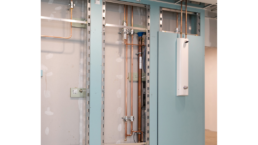
Showersave supports Passivhaus certified school
Showersave, part of The Keystone Group, which provides drain water heat recovery solutions, has collaborated with Currie Community High School to install Waste Water Heat Recovery Systems (WWHRS) as part of the school’s journey to Passivhaus certification.
Located in South West Edinburgh, the new facility, built under the Scottish Government’s Learning Estate Investment Programme (LEIP) accommodates 1,000 students and includes a swimming pool and extensive sports facilities.
LEIP is a joint initiative between national and local governments that aims to modernise learning environments while ensuring they are sustainable, efficient and built for the long term, requiring innovative technology to help achieve this.
Kier Construction
To support the whole-building approach required by Passivhaus, Kier Construction opted to install Showersave’s WWHRS. These systems capture heat from shower waste water and use it to preheat incoming cold water.
The WWHRS can achieve a reduction in the demand for hot water from the heat source by up to 50%, helping meet an operational target of 67 kWh/m2/year.
Showersave systems integrate seamlessly into showers, requiring no change in behaviour from students. With no moving parts or switches, they feature a built-in overflow for safety and are fully reusable and recyclable, making them an environmentally responsible choice.
At Currie Community High School, Showersave has benefited both students and the wider community. The facilities, including the pool, gym and sports hall, are all used outside of school hours, with showering facilities available after exercise. Showersave’s WWHRS ensure every shower taken remains warm, is more efficient while cutting CO2 emissions, and reduces energy costs.
Cameron Loggenberg, Technical Manager at Showersave, commented: “It was fantastic to work alongside Currie Community High School to support their journey to net zero. The integration of Showersave’s WWHRS will significantly reduce energy consumption, lower costs, and improve SAP performance.”
Gerard McCluskey, Mechanical Engineer at Castle, added: “Showersave is an excellent addition to Currie Community High School’s efforts to create a low-carbon, energy-efficient facility for both students and the public.” The WWHRS will help ensure hot water demand does not put strain on the main heat source or drive up energy costs.”
Passivhaus Certification
The project set out to achieve Passivhaus certification. Passivhaus is an internationally recognised energy efficiency standard that reduces reliance on active heating and cooling systems, cutting energy use and carbon emissions.
With buildings being a significant culprit of carbon emissions, accountable for 35% of total global energy consumption, Passivhaus buildings are designed to be net-zero-ready and resilient to future climate conditions.
Taking a whole-building approach, Passivhaus buildings operate with clear, measured targets, focused on high-quality construction to create energy-efficient structures.
Affordable to run, Passivhaus can also offer lower maintenance costs, reduce fuel poverty and open access to green finance. Additionally, decarbonisation is a critical part of our journey to net zero and Passivhaus enables the levels of demand reduction that we will need to achieve net zero.
Showersave
Since 2005, more than 200,000 Showersave systems have been installed across the UK and Europe. Showersave is the only WWHR solution on the market designed, manufactured, and distributed by a single company – streamlining the supply chain and allowing the business to respond swiftly to the fast-evolving demands of the industry.
For more information on Showersave’s waste water heat recovery solutions, call 028 9334 4488, email sales@showersave.com or visit www.showersave.com.
“Showersave is an excellent addition to Currie Community High School’s efforts to create a low-carbon, energy-efficient facility for both students and the public.” The WWHRS will help ensure hot water demand does not put strain on the main heat source or drive up energy costs.”
Gerard McCluskey, Mechanical Engineer at Castle