


Future Homes Made Wonderfully Simple
Driven by the legal requirements of Building Regulations, new homes must comply with ever-evolving standards, including improved fabric efficiency and reduced CO₂ emissions. Compliance is now closely aligned with the proposed Future Homes Standard, encouraging far greater deployment of Heat Pumps in new-build housing and accelerating the move away from traditional gas combi boilers to more low carbon heating systems.
Electrification of Home Heating
As homes transition away from gas, traditional boiler systems are being replaced by heat pumps supported by hot water cylinders. Showersave systems have gained significant credibility following the introduction of the interim Future Homes Standard (Part L 2021) and are now an embedded part of new-build environmental and affordability targets.
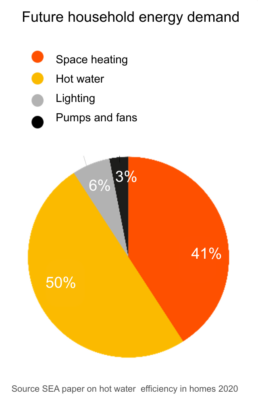
As government policy continues to accelerate the electrification of heat, adoption of heat pumps for space heating is increasing. Combined with earlier fabric-efficiency improvements, this shift means domestic hot water is rapidly becoming the dominant energy load in new homes. Reducing hot water consumption at the point of demand is therefore essential to delivering low-energy, cost-effective homes of the future.
Alongside this, technologies such as Waste Water Heat Recovery (WWHR) have grown in both credibility and importance as part of a whole-house energy strategy. There is now greater emphasis on water reduction alongside energy reduction, enabling innovative solutions not previously possible – most notably the availability of energy-efficient instantaneous electric showers from 2024. These developments in the sector, when considered as part of the whole challenge, collectively deliver impactful cost effective solutions. Space heating, domestic hot water provision and water usage can no longer be treated as mutually exclusive systems, but instead as integrated elements of a more holistic, low-carbon building services approach.
Showersave WWHRS improves domestic hot water systems performance by:
Improving Heat Pump efficiency
WWHRS deliver a 47% reduction in energy for Domestic Hot Water
Smaller Hot Water Cylinder Tank Specification
WWHRS reduce the volume of hot water required by 20% resulting in less wasted energy through standing losses enabling smaller tank specification
Reducing water usage when used with Instantaneous Electric Shower (IES)
Homes with WWHRS and two Instantaneous Electric Showers Litres/day is dramatically reduce by 50%
Seeing is believing when it comes to energy efficiency
Watch this short video that shows Showersave working in real time. After the 30 seconds point, there’s an impressive ~17°C uplift (Sp2). That’s 17°C that your boiler doesn’t need to create. Proof that this is a product that genuinely delivers across residential, commercial, and retrofit projects.
Tony Gordon, Managing Director, Showersave and Phil Viner, Managing Director, Triton Showers, explain how smarter showering can transform energy use in homes.
How WWHRS and IES Improve Hot Water Efficiency
Showersave and Triton Showers are transforming hot water efficiency
Heat Pumps can work more efficiently
“As a house builder, we want to deliver homes that not only meet regulations but also give our partners and customers real value for money. Showersave wastewater heat recovery (WWHR) helps us do exactly that. By reusing heat from shower waste water, it passively reduces energy bills for homeowners while supporting our sustainability goals.
What we like about Showersave is its simplicity. It integrates easily into our homes, requires no ongoing maintenance, and works reliably in the background without the homeowner having to think about it. It’s a low-cost addition that provides a long-term benefit, making our homes more energy efficient and future-proof”.
Jack Brayshaw, Director of Research & Innovation, Vistry Group Plc
The benefits of Waste Water Heat Recovery Systems and next generation IES in Future Homes
In Future Homes, hot water will overtake space heating as the dominant energy load in UK homes. There is also a projected water shortfall of around five billion litres per day by 2050, placing pressure on the housing sector to improve water and resource efficiency. Showering, will play a critical role in meeting regulatory requirements and delivering more sustainable homes.
Part L – Energy Efficiency
- Reduces energy demand by 53% vs mixer x WWHRS*
- Proven to reduce Dwelling Primary Energy Rate (DPER) & Dwellings Emission rate (DER)
- Reduction in grid demand at peak times – reducing infrastructure costs
- Reductions in cylinder sizes:
- Reducing heat losses, increasing system efficiency (less heat pump load)
- Reducing possible design weight load and space challenges
- Faster reheat times
*Gas Boiler, Part L 2021 Regs
Part G – Water Efficiency
- Average water consumption c. 5 l/min – one the most efficient showering solutions
- Enables housebuilders to overcome constraints (water neutrality) sites where water targets <100 l/p/d
- Possible water environmental discount – up to £600 per plot e.g. Essex and Suffolk Water <100 l/p/d
Part Z – Embodied Carbon
- Operational carbon footprint savings negate embodied carbon footprint <3 months! (certified EPDs)
Homeowner
- Improved customer satisfaction / shower experience – more consistent all year round
- Running costs reduced by >£160/annum
- Space-saving
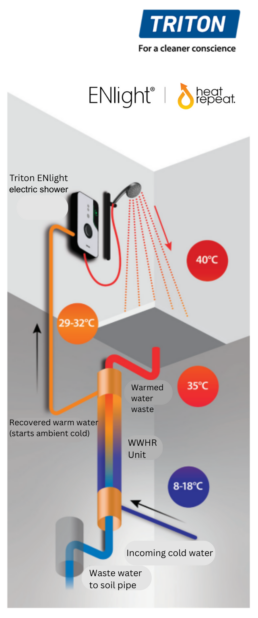
“Waste Water Heat Recovery is one of the most straightforward and cost-effective solutions we recommend. By recovering heat from shower wastewater and pre-warming the incoming cold supply, it significantly reduces the demand on a home’s hot water system. From a compliance perspective, it delivers measurable improvements to DER/TER and DPER/TPER calculations. It’s already part of many of our clients’ strategies and represents a reliable, long-term solution that helps developers meet current standards while preparing for the transition to Future Homes requirements.”
Alex Brooks, Managing Director AES Sustainability Consultants
Read the Showersave White Paper and latest Report to learn more.
Showersave engaged Chris Martin formerly of the Energy Monitoring Company in collaboration with the Centre for Sustainable Technologies at Ulster University, to conduct laboratory tests to evaluate how WWHRS contribute to the performance of domestic Air Source Heat Pumps.
Showersave teamed up with Chris Martin and Triton Showers to explore how Heat Pumps interact with mixer showers, IES, and WWHRS.

“Bloor Homes have used Showersave Waste Water Heat Recovery since its launch in the UK, because it provides a clear, recognised improvement in SAP calculations, thereby helping us achieve compliance with building regulations, but not only that, it is cost efficient and helps reduce homeowners’ energy bills”.
Chris Burton, Group Commercial Director, Bloor Homes
Book a CPD
Find out how Showersave WWHR technology is a cost efficient solution to help optimise SAP calculations and meet Part L Regulations with our Accredited CPD available in person or online.