


The Future Homes Standard (FHS) represents one of the biggest changes to the housebuilding sector in recent decades. As implementation approaches, much of the discussion has focused on technologies such as heat pumps and solar PV. However, here Tony Gordon, Managing Director at Showersave, discusses why one often-overlooked aspect of building performance deserves equal consideration – domestic hot water.
As new homes become more thermally efficient, the balance of household energy use is evolving. Improved insulation and airtightness have significantly reduced the energy required for space heating, meaning domestic hot water now represents one of the largest contributors to overall energy demand. Yet it often receives far less attention during the design and specification process.
For housebuilders and specifiers, this creates an important challenge. If the objective is to create homes that perform well in the real world as well as on paper, the industry must consider not only how energy is generated, but also how efficiently it is used. The most successful developments will combine renewable technologies with practical measures that reduce consumption from the outset.
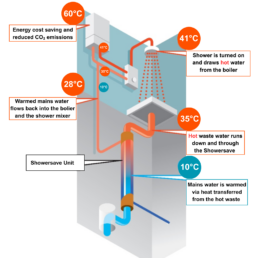
Over the past few years, Waste Water Heat Recovery Systems (WWHRS) have become an increasingly common feature in new-build developments. By recovering heat from shower waste water and using it to pre-heat incoming cold water, these systems reduce the amount of energy needed to produce hot shower water without requiring any change in homeowner behaviour.
For developers, WWHRS offer a practical way of improving overall dwelling performance while supporting compliance with energy efficiency requirements. Unlike many energy-saving measures, the benefits are delivered automatically, providing ongoing reductions in hot water energy demand throughout the lifetime of the property while helping to reduce homeowners’ energy bills.
In the past two years alone, tens of thousands of homes have been fitted with Showersave systems, reflecting the growing recognition that demand reduction technologies play an important role in reducing energy demand and associated carbon emissions in the home.
However, there is concern that evolving compliance methodologies, notably SAP 10.3, may unintentionally place less emphasis on demand-reduction measures.
Worked examples within SAP 10.3 suggest compliance may now be achieved without incorporating these systems, despite the notional dwelling specification including WWHRS. This could create a disconnect between the policy ambition, real world performance, and the way compliance is modelled.
While flexibility remains within the system, there is a growing perception that compliance pathways are becoming increasingly concentrated around a relatively narrow group of technologies.
This matters because every development is different. Site constraints, budgets, dwelling types and infrastructure considerations all influence specification decisions. One of the strengths of previous regulatory approaches was their ability to allow designers and developers to balance different technologies to achieve the required level of performance in the most practical and cost-effective way.
Maintaining this flexibility will be crucial as the FHS is introduced. A broad mix of recognised technologies gives housebuilders greater freedom to adjust specifications to individual developments while still delivering compliant and energy-efficient homes.
Ultimately, Showersave enables housebuilders to deliver more efficient heat pump systems by improving heat pump performance and reducing hot water cylinder size. This translates into tangible benefits for homeowners, including energy bill savings of around £200 a year for a family of four when a heat pump is in use, without requiring any behavioural changes.
The conversation should not be framed as heat pumps versus hot water efficiency, or generation versus demand reduction. These approaches complement each other rather than compete. Low carbon heating technologies perform best when overall energy demand has already been minimised, creating homes that are both more efficient and more affordable to run.
In addition, Showersave’s WWHRS can help reduce build costs beyond compliance alone. By enabling smaller hot water cylinders, they can lower system costs while improving the homeowner experience by reducing the likelihood of running out of hot water. This, in turn, can help minimise customer complaints and contribute to higher HBF Star Ratings, all while improving the overall efficiency of both space heating and hot water generation.
As domestic hot water accounts for an increasingly significant proportion of household energy use, it deserves a much more prominent place in the FHS discussion. By recognising the value of both energy generation and demand reduction, the industry can deliver homes that are compliant on paper and perform efficiently in everyday use.
For housebuilders and specifiers alike, the challenge is not simply delivering compliance at handover. Success will ultimately be measured by delivering homes that continue to perform efficiently for homeowners throughout their lifetime, helping to reduce both carbon emissions and running costs.